As the offseason begins to take shape, the Buffalo Bills are steadily assembling the pieces of their expanded roster, continuing the process of building depth and competition ahead of the upcoming campaign. With the league’s 90 man roster limit serving as the first checkpoint before trimming down to the regular-season squad, the Bills are carefully evaluating talent and revisiting familiar faces who could provide value. Their latest move reflects that approach.
On Wednesday, the organization officially announced the signing of veteran wide receiver Jalen Virgil, a player who already has experience in Orchard Park and understands the culture inside the building. By bringing Virgil back into the fold, Buffalo adds another layer of competition to its offense while also reinforcing special teams and depth at the receiver position. For a team with postseason aspirations, these types of roster additions can play a crucial role in shaping the final lineup.
Virgil is not a newcomer to the Bills’ system. During his previous stint with the franchise, he demonstrated flashes of potential and proved he could contribute when called upon. Most notably, he played a meaningful part during the 2024 season, stepping into responsibilities that helped the team navigate the grind of a long NFL schedule. Whether it was providing depth behind the starting receivers or contributing on special teams, his versatility made him a valuable asset.
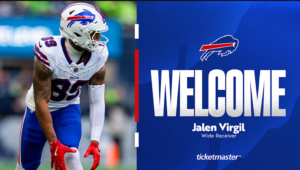
As Buffalo inches closer to offseason workouts and training camp preparations, competition will be at the forefront. The 90 man roster allows teams to bring in veterans, rookies, and developmental prospects to battle for limited spots. Ultimately, only 53 players will make the final regular season roster, meaning every practice rep and preseason snap carries weight. For Virgil, this signing represents another opportunity to carve out a role and prove he belongs in the Bills’ long term plans.
The Bills’ front office has been deliberate in how it approaches roster construction this offseason. Rather than making splashy, headline grabbing moves at every turn, the organization has focused on smart depth additions and maintaining continuity where possible. Re-signing or bringing back players who already know the system reduces the learning curve and allows the coaching staff to evaluate them more efficiently. Virgil fits that mold perfectly.
His familiarity with the offensive scheme, coaching staff, and locker room dynamics gives him a slight advantage compared to newcomers trying to adjust. Coaches already have tape of him within their system, understand his strengths and weaknesses, and know how he responds to pressure situations. That kind of institutional knowledge can be extremely valuable during roster evaluations.
From a broader perspective, wide receiver depth has become increasingly important in today’s NFL. Injuries are inevitable over the course of a 17 game regular season, and teams often need to rely on their fourth, fifth, or even sixth receivers at various points. Having a player like Virgil someone who has already shown he can step in and perform provides insurance and flexibility.
Additionally, players fighting for roster spots often distinguish themselves through special teams contributions. Veterans who embrace that role can significantly improve their chances of sticking around. Given Virgil’s prior involvement and experience, he may once again be tasked with helping in that phase of the game while also competing for offensive snaps.

As the calendar moves closer to organized team activities and mandatory minicamp, the Bills’ roster will continue to evolve. General managers and coaching staffs use this time to evaluate talent, build competition, and identify which players best fit their vision for the upcoming season. Every signing at this stage is part of a larger puzzle.
For Jalen Virgil, returning to Buffalo offers both familiarity and opportunity. He knows the expectations, understands the standard set within the locker room, and now gets another chance to prove he can be part of the team’s success story. With 90 roster spots currently in play and only 53 available once the regular season begins, the battle will be intense.
Still, by reuniting with a player who has already contributed and shown reliability, the Bills are making a calculated move. As they continue shaping their roster for the months ahead, additions like Virgil underscore the organization’s focus on depth, competition, and continuity all essential ingredients as they prepare for another push toward contention.
Jalen Virgil Has Some NFL Experience
Wide receiver Virgil, now 27 years old, first entered the NFL during his rookie campaign with the Denver Broncos after signing as an undrafted free agent in 2022. Although he wasn’t selected in the draft, he managed to carve out an early opportunity and made the most of it. In limited action that season, Virgil recorded two receptions totaling 75 yards. One of those catches was particularly memorable a 66 yard touchdown that came on the very first reception of his NFL career, immediately showcasing his big-play ability and vertical speed.

During that 2022 season, Virgil appeared in nine games and earned one start. While his overall statistical production was modest, his contributions demonstrated flashes of potential. He provided depth at wide receiver and gave the Broncos another option in certain offensive packages. However, his momentum was halted before the 2023 season even began. Virgil was placed on injured reserve prior to kickoff, sidelining him for the entire year. As a result, he did not see the field at all during the 2023 campaign, missing a crucial developmental season.
After spending a full year on injured reserve, Virgil’s time in Denver ultimately came to an end. He was waived the following year, prompting another opportunity elsewhere in the league. Shortly after his release, he caught on with the Buffalo Bills, continuing his NFL journey.
According to team reports, the Bills moved quickly to bring Virgil into the fold. “The Bills signed Virgil to their practice squad the day after he was waived,” the team explained. Initially, he began his tenure in Buffalo as a practice squad player, working behind the scenes while learning the team’s offensive system and competing for a larger role. His efforts eventually paid off, as he was elevated to the active roster.
In 2024, Virgil appeared in seven games for Buffalo. While he did not emerge as a primary target, he contributed as a depth receiver and special teams option. His stint on the active roster demonstrated the team’s confidence in his abilities and his continued perseverance despite previous setbacks.
However, his time on the 53 man roster was not permanent. After those appearances, Virgil was released but subsequently brought back to the practice squad. The Bills later signed him to a future/reserve contract in January 2025, a move that indicated the organization’s interest in keeping him in the mix for the upcoming season. Such contracts are commonly used to retain players during the offseason and give them a chance to compete in training camp.
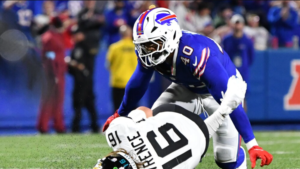
Despite that opportunity, Virgil was waived again before the start of the next season. As a result, he did not appear in any NFL games during the most recent campaign. Instead, he spent part of his time continuing his professional football career in the United Football League, seeking additional playing time and a pathway back to the NFL.
Overall, Virgil’s professional journey has been marked by flashes of promise, perseverance through injury, and multiple roster transitions. From an undrafted free agent who scored on his first career catch with the Broncos, to practice squad and active roster stints with the Bills, and eventually time in the UFL, he has continued to pursue opportunities to extend his career at the professional level.
Bills Could Make Changes to Wide Receiver Corps
Virgil may find himself with a legitimate chance to secure a spot on the roster as the Buffalo Bills head into what is shaping up to be a transformative offseason. The team’s wide receiver corps failed to deliver consistent results throughout the 2025 campaign, leaving the offense searching for answers.

Too often, Buffalo’s pass catchers struggled to create separation from defenders, making life increasingly difficult for quarterback Josh Allen. Opposing defenses took notice, tightening coverage schemes and applying additional pressure on Allen, confident that the Bills’ receivers would have trouble breaking free downfield.
That lack of production has fueled speculation that significant changes could be coming. Around the league, many analysts and insiders believe the Bills are preparing to overhaul their receiving unit in an effort to reignite the offense. With the team facing salary cap considerations and aiming to maximize Allen’s prime years, underperforming veterans may be on the chopping block. The front office appears poised to evaluate every contract and contribution carefully, and some familiar names could be casualties of that review.
One player frequently mentioned in these discussions is Curtis Samuel. According to Sports Illustrated’s Randy Gurzi, Samuel’s future in Buffalo is far from secure. The veteran wideout signed a three year contract worth $24 million prior to the 2024 season, arriving with solid credentials after productive stints elsewhere.
During his final two seasons with the Washington Commanders, Samuel surpassed 600 receiving yards in each year, demonstrating versatility and reliability as a target. Those performances made him an appealing addition for Buffalo, which hoped he could add speed, experience, and playmaking ability to its offense.

However, Samuel has not come close to matching that output since joining the Bills. Gurzi points out that despite the sizable investment, Samuel has struggled to become a meaningful part of the offense. In his first season with Buffalo in 2024, he managed just 31 receptions for 253 yards and a single touchdown.
Those numbers fell well short of expectations for a player brought in to bolster the passing attack. Rather than emerging as a dependable option, Samuel found himself largely on the periphery of the game plan.
The 2025 season proved even more challenging. Injuries significantly limited his availability, further reducing his impact. Samuel appeared in only six games this past year, and his production was minimal just seven catches for 81 yards and one touchdown.
When healthy, he was unable to carve out a consistent role, and when sidelined, the offense struggled to find rhythm without a reliable complement to its other receivers. The combination of low output and missed time has led many to question whether retaining Samuel makes financial or competitive sense.
Gurzi suggests that the Bills could opt to release Samuel as part of their offseason restructuring. Doing so would reportedly free up at least $6 million in salary cap space, funds that could be redirected toward other areas of need. For a team attempting to remain competitive in a loaded AFC while managing cap constraints, that kind of savings is significant. Cutting ties with Samuel would not only create financial flexibility but also signal a commitment to refreshing a unit that has underachieved.
If Samuel is indeed let go, opportunities could open for younger or less established players such as Virgil to claim meaningful roles. With several veteran receivers potentially on their way out, roster spots may be more attainable than in previous years.
Training camp and preseason competitions could take on added importance, as the coaching staff evaluates who can best complement Allen and provide the separation and reliability the offense so clearly lacked.

Beyond internal options, the Bills are widely expected to explore external avenues to upgrade their receiving talent. The NFL Draft presents one logical path. Buffalo could use an early round pick to secure a dynamic, cost controlled wideout capable of stretching the field or serving as a dependable possession target. Adding young talent would align with both financial prudence and long-term roster planning, giving Allen a potential new weapon while preserving cap flexibility.
At the same time, trade rumors have begun circulating. One name that has surfaced albeit as a long shot possibility is Minnesota Vikings superstar Justin Jefferson. Jefferson has reportedly expressed some frustration with his current situation, sparking speculation about his future. While prying away a player of his caliber would likely require a massive package of draft capital and potentially significant financial commitments, the mere connection underscores Buffalo’s desire to dramatically upgrade its receiving corps.
Realistically, landing a player like Jefferson would be difficult. Still, the fact that Buffalo has been mentioned in such discussions reflects the urgency surrounding its offensive struggles. The Bills understand that to compete for a Super Bowl, they must provide Allen with a stronger supporting cast.
Defenses have grown comfortable challenging Buffalo’s receivers one on one, often daring them to win individual matchups. Without consistent separation and explosive plays, the offense has been forced to operate in tighter windows, increasing the degree of difficulty on nearly every snap.
As the offseason unfolds, the Bills’ strategy will come into clearer focus. Whether through releasing underperforming veterans like Samuel, investing in draft prospects, or exploring bold trade scenarios, change appears inevitable. For players like Virgil, this transitional period represents both uncertainty and opportunity. If he can seize the moment, impress the coaching staff, and demonstrate the ability to create space and contribute consistently, he could emerge as part of the solution to Buffalo’s offensive woes.
Ultimately, the Bills face a pivotal stretch. With Allen firmly established as the franchise cornerstone, the organization must ensure it surrounds him with the right pieces. The wide receiver unit’s shortcomings in 2025 exposed vulnerabilities that opponents exploited repeatedly. Addressing those weaknesses will be essential if Buffalo hopes to reestablish itself as a dominant force in the AFC.