Although Jordan Poyer has publicly backed the Buffalo Bills’ decision to elevate Joe Brady as the franchise’s next head coach, the veteran safety made it clear that he was unhappy with how the organization parted ways with Sean McDermott. Poyer’s comments offered a layered perspective one that balanced optimism for the team’s future with lingering disappointment over the departure of the coach who helped shape his career in Buffalo.
Poyer shared his thoughts during an appearance on Chris Simms’ Simms Unbuttoned podcast on Wednesday. The interview took place as Poyer walked through Radio Row in the buildup to Super Bowl LX, providing a relaxed but revealing backdrop for a wide ranging conversation. Throughout the discussion, Poyer touched on several topics that spanned both his personal journey and the broader evolution of the Bills organization.
The veteran defensive back reflected on his early days in Buffalo, including a humorous anecdote about messaging Simms directly after taking issue with one of his play evaluations. That moment served as a reminder of how deeply Poyer has always cared about both his performance and how the team is perceived externally. He also took time to heap praise on quarterback Josh Allen, emphasizing Allen’s leadership, competitiveness, and growth into one of the league’s elite signal callers.

However, the most compelling segment of the interview came when the conversation shifted to Sean McDermott. Poyer spoke candidly about the former head coach, under whom he experienced the most productive and successful stretch of his NFL career. After arriving in Buffalo, Poyer blossomed into a cornerstone of McDermott’s defense, earning All Pro recognition and becoming one of the league’s most respected safeties.
Poyer credited McDermott for creating an environment that allowed him to thrive both on and off the field. He highlighted the coach’s attention to detail, defensive acumen, and ability to build trust within the locker room. For Poyer, McDermott was more than just a schemer or disciplinarian he was a mentor who believed in his players and consistently put them in positions to succeed.
That personal connection made McDermott’s dismissal particularly difficult for Poyer to process. While he stopped short of criticizing the organization outright, his disappointment was evident. From Poyer’s perspective, McDermott was instrumental in transforming the Bills from a struggling franchise into a perennial contender, and his impact should not be understated. The decision to move on, while perhaps rooted in the team’s desire for a new direction, still felt abrupt to someone who had lived through the program’s rise firsthand.
At the same time, Poyer acknowledged that the NFL is a results driven business where change is often inevitable. He recognized that front offices must make difficult choices in pursuit of championships, even when those decisions carry emotional weight. That understanding allowed him to express support for Joe Brady, who now steps into one of the league’s most demanding roles.
Poyer spoke positively about Brady’s offensive mind and his ability to connect with players, particularly on the offensive side of the ball. He noted that Brady brings a fresh perspective and energy that could help the Bills take the next step, especially with a quarterback like Allen entering his prime. While Poyer’s own role as a defensive leader limited his direct interaction with Brady, he expressed confidence that the new head coach has the tools to succeed.

Still, Poyer’s comments underscored the complexity of transitions in professional sports. Supporting the future does not automatically erase appreciation for the past. His reflections served as a reminder that behind every coaching change are relationships, shared successes, and years of mutual trust that do not simply disappear overnight.
In the end, Poyer’s interview painted a nuanced picture of a veteran player navigating change. He embraced optimism about what lies ahead for the Bills under Joe Brady, while remaining candid about the respect and loyalty he still holds for Sean McDermott. That balance hopeful yet reflective captured both the reality of the NFL and the human side of a league often defined by wins, losses, and headlines.
Poyer’s loyalty to his coach
Jordan Poyer didn’t hide his emotions when asked about the decision that sent shockwaves through Buffalo. The veteran safety, who has spent a significant portion of his career under Sean McDermott, admitted that the news was difficult to process, both professionally and personally. Reflecting on his history with the former Bills head coach, Poyer made it clear that their relationship runs far deeper than football.
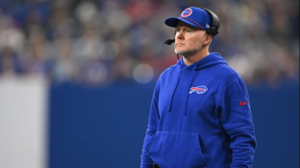
“I love Sean,” Poyer said when discussing the firing. He pointed back to 2017, the year McDermott arrived in Buffalo and the two began building something meaningful together. That period marked a turning point not just for the organization, but for Poyer’s career as well. The Bills were coming off years of inconsistency, and McDermott’s arrival brought a new sense of direction, accountability, and belief. Poyer was one of the players who fully bought into that vision.
“To go there in 2017 and help build that program alongside Sean,” Poyer continued, “it’s a tough pill to swallow.” His words carried the weight of shared struggles, shared successes, and countless hours spent grinding toward a common goal. For players like Poyer, McDermott wasn’t just a coach calling plays or setting practice schedules he was the foundation of the culture they helped create.
That bond only grew stronger during Poyer’s return to Buffalo in 2025. By that point, their relationship had evolved beyond the locker room. Poyer revealed that he and McDermott became neighbors during that time, a detail that highlights just how intertwined their lives had become. Living so close allowed them to connect on a more personal level, away from the pressures of game plans and weekly results.
Those off-field interactions gave Poyer a deeper appreciation for McDermott as a person, not just as a coach. He spoke glowingly about McDermott’s character, emphasizing the integrity and leadership qualities that made him such a respected figure within the organization and the city itself.
“He’s just a stand up human being,” Poyer said. “He’s the kind of person you want representing your football team and your city.” That sentiment speaks volumes, especially coming from a veteran who has seen multiple locker rooms, coaching styles, and leadership approaches throughout his NFL journey. For Poyer, McDermott embodied stability and professionalism traits that don’t always show up in box scores but matter immensely over the long haul.

Despite his admiration for McDermott, Poyer was careful to acknowledge the new direction Buffalo is heading. He made sure to express his respect and enthusiasm for Joe Brady, who has stepped into a more prominent role following the coaching change. While Poyer made it clear that he didn’t personally agree with the decision to move on from McDermott, he also understands the reality of the NFL: change is inevitable, and teams must adapt.
Poyer spoke highly of Brady’s offensive acumen, describing him as someone with a sharp football mind and a clear vision. His praise wasn’t lukewarm or obligatory it was genuine. Poyer emphasized his belief in Brady’s ability to guide the team forward and maximize the talent on the roster.
“If there was somebody I wanted to be in that position, it’s Joe Brady,” Poyer said. That statement carried significant weight, especially given the circumstances. It underscored Poyer’s ability to separate personal feelings from professional judgment. Even though he disagreed with how things unfolded, he recognized Brady as the right person to take the reins moving forward.
“Do I agree with the firing of Sean? No,” Poyer admitted candidly. “But it is what it is. We move on.” That matter of fact acceptance reflects the mindset of a seasoned veteran who understands that dwelling on the past doesn’t change the future. For Poyer, the focus now shifts to what comes next for the team and for himself.
The changes in Buffalo extend beyond the head coach’s office. Poyer also expressed excitement about the possibility of playing under Jim Leonhard, another familiar face from his past. Leonhard, a former teammate, represents a new but comfortingly familiar presence within the organization. For Poyer, the idea of playing for someone who once shared the field with him brings a unique sense of trust and understanding.

Leonhard’s impact on Poyer dates back to their time together in Cleveland. As a young player trying to find his footing in the league, Poyer leaned heavily on veterans like Leonhard and other former Browns safeties. Those early years were formative, shaping not only his on field instincts but also his approach to professionalism.
“My early days in Cleveland,” Poyer recalled, “those guys really paved the way for me.” He credited Leonhard and others with teaching him what it truly meant to be a professional at the NFL level. From film study to preparation habits to understanding the mental side of the game, those lessons laid the groundwork for Poyer’s longevity and success.
“Learning how to be a pro, learning how to watch film, learning how to study,” Poyer said. Those skills don’t fade with age; if anything, they become more valuable. The idea that Leonhard could now be in a position of leadership in Buffalo adds an intriguing layer to Poyer’s future. It represents a full circle moment the student potentially playing under the guidance of someone who once mentored him.
Still, uncertainty looms. As of now, there is no definitive word on whether Poyer will be part of the Bills’ plans in 2026. His future remains up in the air, not just with Buffalo, but across the league. At this stage of his career, every season is evaluated carefully, balancing physical readiness, opportunity, and personal priorities.
Yet it’s impossible to ignore the emotional weight of everything Poyer has experienced with the Bills, particularly his relationship with McDermott. Their connection extended beyond wins and losses, rooted in shared values and mutual respect. That kind of bond doesn’t disappear overnight, even when circumstances force a separation.

A part of Poyer, whether he admits it openly or not, is undoubtedly reflecting on those years the growth, the challenges, and the trust they built both on and off the field. From their early days reshaping the franchise to becoming neighbors years later, the journey they shared is woven deeply into Poyer’s career narrative.
As Buffalo moves forward into a new era, Poyer stands at a crossroads of his own. He carries with him lessons from McDermott, belief in Brady’s vision, and appreciation for figures like Leonhard who helped shape him long before he became a household name. Whether he suits up for the Bills again or takes his talents elsewhere, those experiences will continue to define who he is as a player and as a professional.
For now, Poyer remains realistic, reflective, and respectful of the process. The NFL rarely allows for perfect endings, but it does offer opportunities for reinvention. As he waits to see what 2026 holds, one thing is clear: the relationships he forged in Buffalo especially with Sean McDermott will remain a lasting and meaningful chapter in his story.