The Boston Red Sox made a calculated and somewhat unconventional trade on Sunday, one designed less around immediate on field impact and more around financial flexibility and roster management. In an effort to ease payroll pressure and reshape their 40 man roster, the club sent two right handed pitchers Jordan Hicks and David Sandlin to the Chicago White Sox, along with a significant cash payment, in exchange for right-hander Gage Ziehl.
Multiple sources confirmed the deal to MassLive, and the transaction was first reported by ESPN insider Jeff Passan before being formally announced by both organizations. Beyond the players immediately named, the agreement includes additional moving parts, Boston will send two players to be named later to Chicago, while the White Sox will eventually send one player to be named later back to the Red Sox. When all components are accounted for, the trade ultimately involves six total players.
At its core, the deal reflects Boston’s ongoing effort to create breathing room within its payroll structure after a winter marked by aggressive spending. The Red Sox had already added major financial commitments earlier in the offseason, bringing in catcher Willson Contreras and pitchers Sonny Gray and Ranger Suárez. Those acquisitions pushed the club’s payroll well into the competitive balance tax (CBT) penalty range, making Hicks’ contract an increasingly uncomfortable fit.
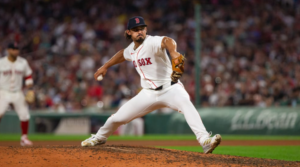
Hicks’ salary, which originated from the two year deal he signed with the San Francisco Giants in January 2024, carried a competitive balance tax hit of $12 million in each of the next two seasons. By sending Hicks to Chicago and attaching $8 million in cash per year, the Red Sox effectively reduced their CBT responsibility for the pitcher to just $4 million annually. In real dollar terms, Hicks is owed $12.5 million in each of the next two seasons, but Chicago will now absorb $8.5 million per year of that obligation.
For Boston, the financial relief was substantial enough to justify including Sandlin, a pitcher widely viewed as one of the more intriguing arms in the organization. Sandlin had only recently been added to the Red Sox’s 40 man roster, a move that underscored how highly the club regarded his upside. In return, Boston received Ziehl, a younger pitcher who currently profiles as more of a developmental project.
The trade also clears two spots on Boston’s 40 man roster, a subtle but meaningful benefit as the club continues to explore roster tweaks ahead of spring training. That flexibility could prove valuable in the coming weeks as the front office evaluates additional free agent opportunities, trade possibilities, or internal promotions.
Hicks’ tenure with the Red Sox was brief and largely disappointing. Acquired as part of the blockbuster June trade that sent Rafael Devers to the Giants, Hicks struggled mightily after arriving in Boston. Over 21 appearances, he logged just 18⅔ innings while posting an unsightly 8.20 ERA. His command was inconsistent, as he issued 12 walks and surrendered three home runs during that stretch. His season came to an abrupt end in early September due to a shoulder injury, preventing him from finishing the year on the mound.
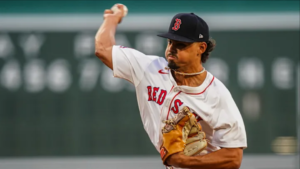
Had he remained with the club, the 29 year old would likely have entered spring training with a chance to compete for a bullpen role, though his spot would have been far from guaranteed given the depth Boston has assembled. Instead, the Red Sox opted to move on, prioritizing financial clarity over the possibility of a rebound season.
This trade marks the second time Boston has dealt away a player acquired in the Devers trade. Earlier, outfielder James Tibbs III was sent to the Los Angeles Dodgers at the trade deadline in exchange for pitcher Dustin May. Of the four players originally obtained in that deal, only left hander Kyle Harrison and right-hander Jose Bello remain in the Red Sox organization.
Behind the scenes, the negotiations between Boston and Chicago were more complex than the final trade suggests. According to a source familiar with the talks, the two teams explored several different frameworks that involved varying degrees of financial responsibility for Hicks’ contract. One proposed structure would have had Boston take on less cash but receive White Sox reliever Jordan Leasure, a pitcher viewed as capable of contributing immediately at the major league level.
Ultimately, Boston chose a different path. Rather than adding a bullpen arm with limited upside, the Red Sox elected to send additional money and Sandlin in order to take back Ziehl, a less polished but younger pitcher who finished last season at the High A level. The decision reflects Boston’s preference for longer term roster flexibility over short term bullpen depth.
Sandlin, who will turn 25 later this month, has steadily climbed prospect rankings since arriving in the organization two years ago. He was acquired from the Kansas City Royals in exchange for reliever John Schreiber, a deal that initially flew under the radar but has since drawn praise as Sandlin’s profile has grown. Baseball America recently ranked him as the No. 11 prospect in the Red Sox system, citing his arm strength and improving pitch mix.
The White Sox, according to sources, had tracked Sandlin for some time and viewed the opportunity to acquire him as a worthwhile return for absorbing a portion of Hicks’ contract. Sandlin reached Triple A for the first time last season but encountered difficulties after the Red Sox shifted him into a bullpen role late in the year. Across 106 innings split between Double A Portland and Triple A Worcester, he posted a 4.50 ERA while making 32 appearances, including 14 starts.
Despite those struggles, Boston clearly believed Sandlin was close to contributing at the big league level. He was added to the 40 man roster early in the offseason to protect him from the Rule 5 draft and was expected to open the upcoming season in Worcester’s rotation. That group likely would have included Harrison, Tyler Uberstine, Jake Bennett, Shane Drohan, and other pitchers on the cusp of the majors. Internally, Sandlin was viewed as a potential candidate to make his MLB debut sometime in 2026.
Ziehl, meanwhile, enters the Red Sox system having already experienced significant movement early in his professional career. At just 22 years old, he has now been traded twice in an eight month span. Originally selected by the New York Yankees in the fourth round of the 2024 draft, Ziehl signed for an over-slot bonus of $637,000 out of the University of Miami. The Yankees dealt him to Chicago at the trade deadline in exchange for outfielder Austin Slater.
Ziehl made his professional debut last season and progressed rapidly through multiple levels of the minor leagues. He reached Double A for a single outing and finished the year with a combined 4.12 ERA across 107 innings in 22 games, 21 of which were starts. His final six appearances came at High A Winston Salem, where he continued to refine his command and secondary offerings.
While Ziehl does not currently project as an immediate contributor, Boston views him as a controllable arm with developmental upside. His age, workload capacity, and collegiate background suggest there may be more growth ahead as he adjusts to professional instruction and workload demands.
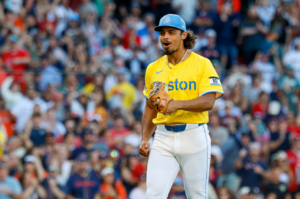
From a broader organizational standpoint, shedding Hicks’ salary even with the accompanying cost in prospects and cash gives the Red Sox greater freedom as they prepare for spring training. Public estimates placed Boston’s CBT payroll at approximately $269 million following the signing of Ranger Suárez to a five year, $130 million contract. That figure pushed the team beyond both the first and second luxury tax thresholds.
After this trade, Boston’s CBT number now sits closer to $261 million, placing it below the second threshold of $264 million. That distinction matters, as crossing additional thresholds brings steeper financial penalties and draft related consequences.
The Red Sox still have notable roster questions to address, particularly in the infield. Openings remain at second base and third base, with top prospect Marcelo Mayer potentially factoring into the mix at one of those positions. Boston remains active in exploring both free agent and trade options to fill those gaps, and the financial relief created by the Hicks trade makes such moves more feasible.
Further salary maneuvering is also possible. The Red Sox could look to move another high cost player in the coming weeks, with Masataka Yoshida and Patrick Sandoval among the names that could draw interest. Yoshida carries an $18 million CBT hit, while Sandoval’s tax figure sits at $9.125 million. Neither player currently has a clearly defined role given the roster’s present construction, making them potential candidates for additional payroll adjustments.
In the end, the trade with Chicago underscores the balancing act facing the Red Sox as they attempt to contend while managing long term financial commitments. While losing a pitcher like Sandlin stings from a talent standpoint, the organization clearly valued the flexibility gained through the deal. Whether that flexibility ultimately translates into a more complete roster remains to be seen, but the move signals that Boston is far from finished reshaping its team ahead of Opening Day.