Former Los Angeles Dodgers utility player Chris Taylor found himself beginning the 2026 season in a somewhat uncertain position, but he ultimately secured another opportunity to continue his professional baseball career. Early in the year, he agreed to a deal with the Los Angeles Angels, giving him a pathway back into Major League Baseball after entering free agency.
According to reports from Jeff Fletcher of the Orange County Register, Taylor’s agreement with the Angels came in the form of a minor league contract. The signing took place only a few days after he had officially become available on the open market, suggesting that there was at least some level of interest in his services despite his recent struggles.
While the contract did not guarantee him a spot on the major league roster, it did provide him with a chance to prove himself during spring activities and potentially earn a call up later in the season.

However, things did not unfold smoothly right away. Taylor was ultimately left off the Angels’ Opening Day roster, a development that prompted him to make a significant decision regarding his future.
Rather than remain with the organization under those terms, he exercised an opt out clause in his contract, choosing to re-enter free agency and explore other possible opportunities elsewhere. This move indicated both his desire to compete at the highest level and his belief that he might find a more immediate path back to the majors.
After briefly surveying the landscape and considering his options, Taylor ended up returning to the Angels organization. This time, the arrangement placed him at the Triple A level, where he would look to rebuild his value and demonstrate that he still possesses the skills necessary to contribute in the big leagues.
His return reflects a combination of persistence and practicality while he may not have secured a major league roster spot right away, he positioned himself in an environment where strong performance could quickly change that.
During spring training, Taylor showed encouraging signs at the plate. Over the course of 15 Cactus League appearances, he produced a .231/.388/.410 slash line. While not overwhelming, those numbers represented a noticeable improvement compared to his output over the previous two seasons.
In that earlier stretch, Taylor struggled significantly, finishing with a 66 OPS+, a figure that falls well below the league average and underscores the challenges he has faced offensively in recent years. His spring performance, therefore, offered at least a glimmer of hope that he could rediscover some of the form that once made him a valuable contributor.
Despite the ups and downs of his recent career, Taylor has remained steadfast in his confidence that he can still play at the highest level. Even during the offseason, when he found himself without a team and facing the uncertainty that comes with free agency, he never seriously considered stepping away from the game. Retirement, in his mind, was simply not an option.
He made that mindset clear during an appearance on “Dodger Talk” with David Vassegh. Speaking candidly, Taylor dismissed any notion that he might be nearing the end of his career.
He emphasized that he was still actively training in Arizona and preparing for the upcoming season, even if he did not yet know which team he would ultimately join. His comments reflected both determination and a deep love for the game, as well as a belief that another opportunity would eventually present itself.
Taylor’s recent struggles can be traced in part to physical setbacks. During the 2025 season, he dealt with a broken arm while playing for the Angels, an injury that clearly impacted his performance.
That campaign turned out to be one of the most difficult of his career, as he posted a 55 OPS+, marking a career low. Injuries of that nature can disrupt timing, mechanics, and overall confidence at the plate, making it difficult for even experienced players to perform at their usual level.
Given those circumstances, it is not entirely surprising that Taylor has had to settle for a minor league deal as he attempts to work his way back. Still, his track record and versatility he has long been known for his ability to play multiple positions could work in his favor as the season progresses. Teams often value players who can provide flexibility and depth, especially over the course of a long and demanding season.
As for the Angels, their roster situation may also create an opening for Taylor. The team is not widely regarded as one of the strongest in the league, and there are areas where additional production could be beneficial. If Taylor is able to perform well at the Triple A level, it would not be surprising to see him earn another call up to the majors at some point during the 2026 campaign.

Ultimately, Taylor’s journey at this stage of his career is defined by resilience and determination. After experiencing a decline in performance and dealing with injury setbacks, he has continued to pursue opportunities to compete, refusing to let recent struggles dictate the end of his story. His decision to return to the Angels organization, even after opting out initially, highlights his willingness to take whatever path is necessary to get back to the big leagues.
Whether he ultimately re-establishes himself as a productive major league player remains to be seen. However, his recent spring training performance, combined with his unwavering belief in his abilities, suggests that he is not ready to fade away quietly. Instead, he is embracing the challenge of proving himself once again, using his time in Triple A as a platform to show that he still belongs on a major league roster.
In a sport where careers can be unpredictable and opportunities can come and go quickly, Taylor’s situation serves as a reminder of the perseverance required to stay in the game. For now, he continues to work, train, and compete, holding onto the expectation that another chance at the highest level is within reach.
Chris Taylor’s legacy with the Dodgers
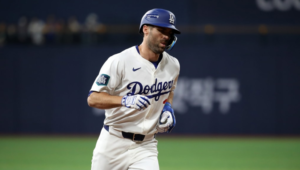
Chris Taylor has long been regarded as a standout figure in Dodgers history, widely viewed as one of the most compelling player development success stories of the Andrew Friedman front office era. When Friedman and his staff identified Taylor early in his career, he was not yet the polished, versatile contributor he would eventually become.
Through a combination of opportunity, coaching, and his own persistence, Taylor transformed himself into a dependable and impactful major league player, exceeding many of the expectations that surrounded him when he first arrived in Los Angeles.
Over time, Taylor carved out a reputation as a player who could be counted on in a wide variety of situations. His growth mirrored the Dodgers’ broader organizational philosophy finding undervalued talent and helping it flourish.
Taylor embraced that philosophy, steadily improving his offensive production while refining his defensive abilities. His journey from a relatively unheralded acquisition to a key contributor on a championship caliber roster stands as a testament to both his work ethic and the Dodgers’ developmental system.
One of the most significant aspects of Taylor’s career with Los Angeles has been his role in the team’s championship success. He played an important part in helping the Dodgers capture two World Series titles, contributing both with his bat and his defensive flexibility.

His presence during those championship runs added depth and reliability to the roster, allowing the team to adapt to various in game scenarios. Taylor was never just a role player; he was often right in the middle of critical moments that shaped the outcomes of games and, ultimately, entire postseason series.
Perhaps one of the defining highlights of his career came during the 2017 postseason, when he delivered a remarkable performance that earned him the National League Championship Series Most Valuable Player award. During that series, Taylor showcased his ability to rise to the occasion under immense pressure, delivering timely hits and making key plays that propelled the Dodgers to the World Series.
His performance in that series remains one of the most memorable individual postseason efforts in franchise history, cementing his status as a player who thrives on the big stage.
In addition to his postseason heroics, Taylor also achieved individual recognition during the regular season by earning a spot on the All Star team. This accomplishment further underscored his development into a well rounded and respected player across the league.
Considering his physical profile standing at six feet tall with a lean, wiry build Taylor maximized his natural abilities through skill, intelligence, and determination. He was not the prototypical power hitter or physically imposing athlete, yet he consistently found ways to produce and contribute at a high level.
Another hallmark of Taylor’s value to the Dodgers has been his remarkable versatility. Few players have demonstrated the ability to move seamlessly across as many positions as he has. Whether stationed in the infield or patrolling the outfield, Taylor provided the Dodgers with immense flexibility.
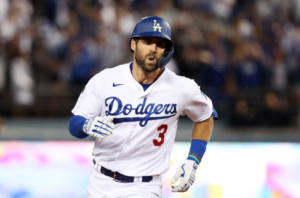
This adaptability allowed managers to construct lineups creatively and respond to injuries or strategic needs without sacrificing performance. His willingness to embrace different roles made him an indispensable part of the roster over multiple seasons.
Beyond his statistical contributions and positional flexibility, Taylor built a strong connection with Dodgers fans through his knack for delivering in clutch situations. Time and again, he came through with critical hits during high stakes postseason games, moments that fans remember long after the final out.
These timely contributions helped define his legacy, as he repeatedly demonstrated composure and confidence when the pressure was at its highest. For many supporters, Taylor became synonymous with postseason resilience and reliability.
His career with the Dodgers reflects a broader narrative about perseverance and growth in professional sports. Taylor was not initially viewed as a future star, yet he steadily evolved into a key figure on one of baseball’s most successful teams.
His journey illustrates how opportunity, preparation, and determination can intersect to create something special. Within the context of the Dodgers’ modern era, Taylor stands out as a player who not only benefited from the organization’s approach but also embodied it.
In the end, Chris Taylor’s legacy with the Dodgers is defined by more than just accolades or championships. It is shaped by his consistency, adaptability, and ability to deliver when it mattered most. From his early days as a relatively unknown acquisition to his emergence as a postseason hero and All Star, Taylor’s career arc represents one of the most satisfying success stories in recent Dodgers history.