The Los Angeles Chargers have fully turned the page toward the 2026 offseason, a period that already feels pivotal for a franchise attempting to find long term stability under Jim Harbaugh. With the dust settled on the 2025 campaign, the organization now finds itself navigating a landscape shaped by both expected turnover and unresolved roster questions.
As is often the case with teams coming off a season of mixed results, the Chargers are dealing with significant changes on the coaching staff, reassessing key personnel decisions, and confronting weaknesses that were exposed over the course of the year none more glaring than the offensive line.
One of the most notable developments of the early offseason has come on the defensive side of the ball. Jesse Minter, who played an instrumental role in shaping one of the league’s better defensive units in 2025, has moved on to become the head coach of the Baltimore Ravens.
Minter’s departure was not entirely surprising given the success the Chargers had under his guidance and the league wide demand for innovative defensive minds. His ability to blend aggression with discipline helped elevate the Chargers’ defense into the league’s upper tier, and that success made him an obvious candidate for a head coaching opportunity.
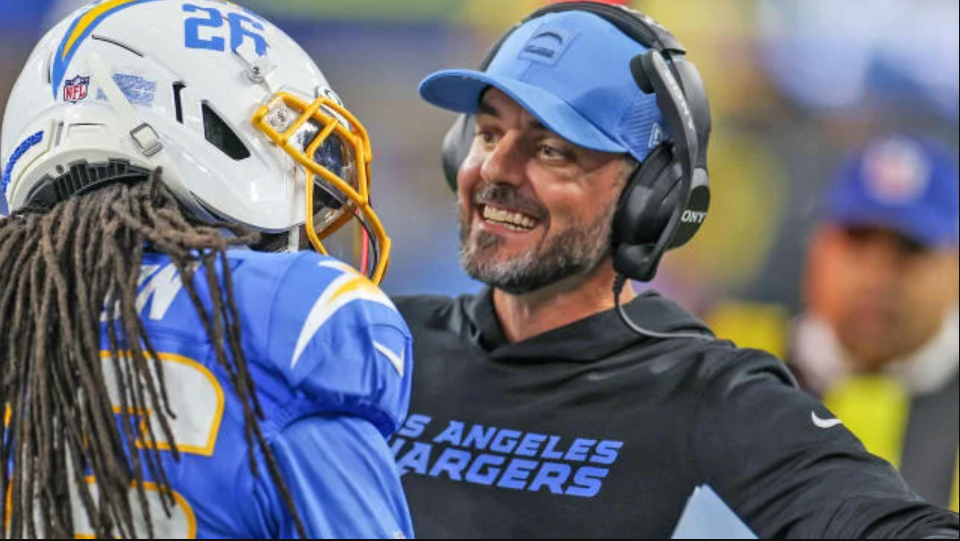
With Minter gone, Jim Harbaugh wasted little time in turning to a familiar face. Chris O’Leary, who previously served as the team’s safeties coach, has returned to the organization and will take over as defensive coordinator for the 2026 season.
O’Leary’s reunion with Harbaugh brings a sense of continuity and philosophical alignment, something Harbaugh has long valued in his coaching staffs. While O’Leary will face the challenge of maintaining the defensive standards set by his predecessor, his familiarity with the roster and Harbaugh’s system should ease the transition.
Beyond the coaching carousel, much of the Chargers’ offseason narrative continues to revolve around general manager Joe Hortiz and the roster decisions that will ultimately define the next phase of the franchise.
Hortiz’s tenure has been marked by a willingness to blend veteran experience with calculated risk, a strategy that produced mixed results in 2025. On one hand, several of his moves paid immediate dividends and helped keep the Chargers competitive. On the other, some high profile decisions failed to deliver the stability the team desperately needed.
Looking back at last offseason provides a useful snapshot of Hortiz’s approach. One of his most significant decisions was bringing back veteran wide receiver Keenan Allen. Despite entering the later stages of his career, Allen remained a reliable and productive target, finishing the season as the Chargers’ leading receiver with 81 catches. His presence provided consistency in the passing game and a trusted option in critical moments, particularly for a team still finding its offensive identity under Harbaugh.
Hortiz also made a notable addition in the secondary by signing veteran cornerback Donte Jackson to a two-year contract. Jackson, who previously played for the Carolina Panthers and Pittsburgh Steelers, brought speed, instincts, and a ball hawking mentality to the Chargers’ defense.
His impact was immediate and tangible. Jackson became a key contributor for a defense that finished the season ranked fifth in the league, often matching up against top receivers and creating turnovers that shifted momentum in crucial games. In many ways, his signing represented the kind of low risk, high reward move that front offices strive for in free agency.
That contrast between success and disappointment was highlighted recently by Bradley Locker of Pro Football Focus, who conducted a league wide evaluation of each team’s 2025 free agent class. Locker identified both the most effective and the least successful additions for all 32 franchises, offering a data driven snapshot of how offseason investments translated on the field.
For the Chargers, the positive selection came as little surprise. Locker pointed to Donte Jackson as the team’s best free agent acquisition, citing his performance metrics and overall influence on a defense that exceeded expectations. Jackson’s ability to hold up in coverage while also contributing as a playmaker validated the Chargers’ decision to target him and underscored the importance of smart veteran signings.
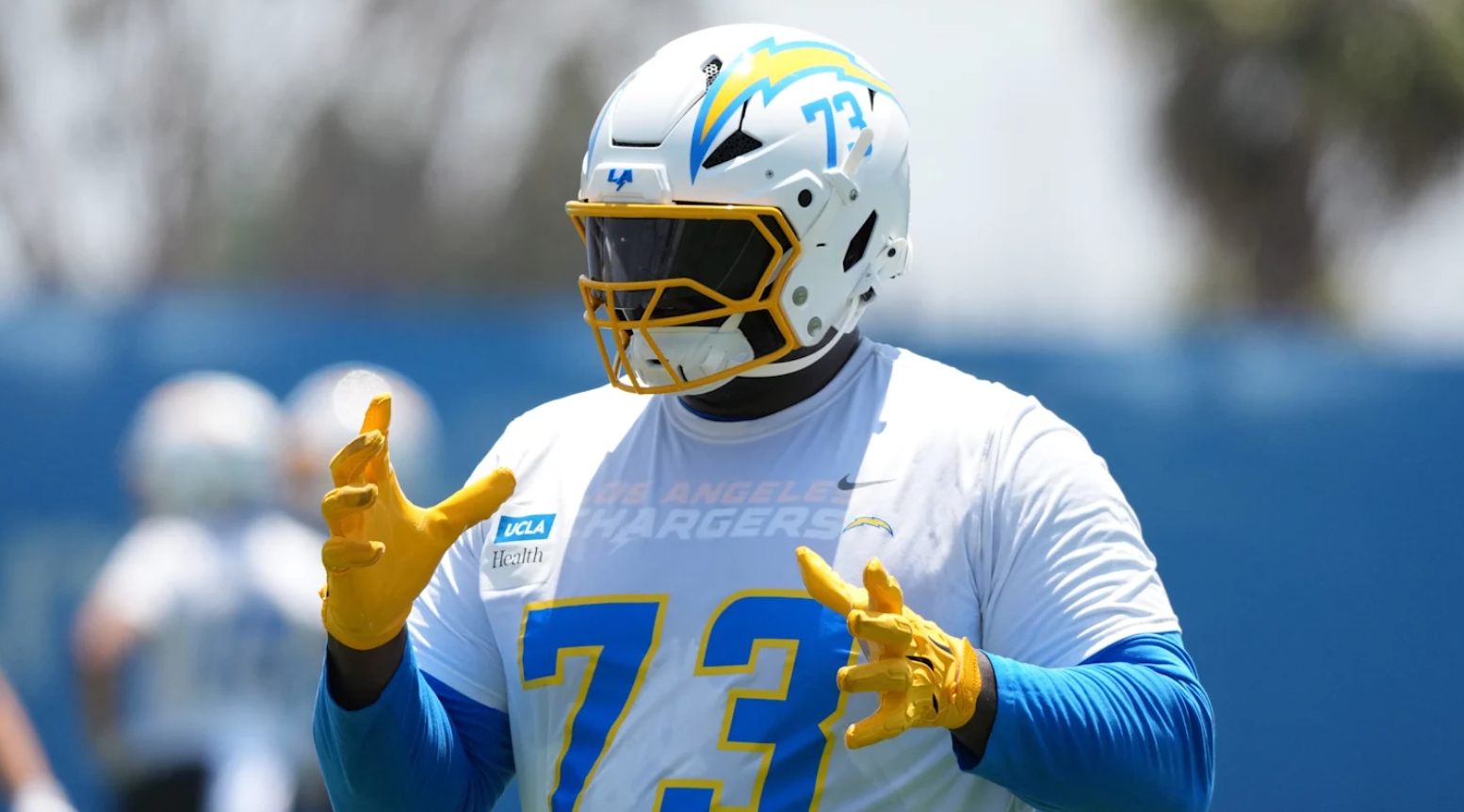
The negative assessment, however, cut far deeper. Locker identified offensive lineman Mekhi Becton as the Chargers’ worst free agent addition of the 2025 offseason a label that encapsulated many of the frustrations surrounding the team’s offensive struggles.
The Chargers entered last offseason with high hopes for Becton. Fresh off a Super Bowl victory with the Philadelphia Eagles, the former first round pick was expected to bring size, power, and championship pedigree to the interior of the offensive line. The belief was that Becton could stabilize a unit that had long been plagued by inconsistency, injuries, and underperformance. Instead, the results were the polar opposite of what the organization envisioned.
According to Locker’s analysis, Becton’s performance declined sharply over the course of the season. His overall Pro Football Focus grade dropped to 36.6, making him the second lowest rated qualified guard in the entire league. Even more troubling was the lack of competency in both core aspects of his role. He failed to reach a 47.0 grade in either pass protection or run blocking, numbers that reflect persistent struggles rather than isolated bad games.
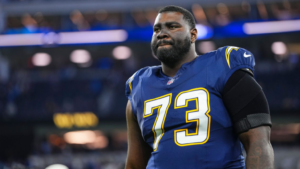
Those metrics painted a stark picture of a player who was unable to meet the physical and technical demands of the position. Whether it was missed assignments, poor leverage, or difficulty handling quicker interior rushers, Becton consistently found himself on the wrong side of the play. For a team that values trench play as a foundational principle particularly under Harbaugh this was an unacceptable outcome.
From a surface level perspective, Becton’s availability might suggest reliability. He appeared in 15 regular season games and started 14 of them, including a start in the Chargers’ playoff loss to New England. Durability, which had been a concern earlier in his career, was not the primary issue in 2025. Instead, the problem was effectiveness. Simply being on the field was not enough, especially when his presence coincided with breakdowns across the offensive line.
Financially, the Chargers had protected themselves against exactly this type of scenario. Last March, Hortiz signed Becton to a two year, $20 million contract, but the deal was structured in a way that allowed the team to exit after the first year without incurring significant long term consequences. That flexibility now looms large as the Chargers evaluate their options. Given Becton’s performance, it would hardly be surprising if the organization chose to move on and redirect resources elsewhere.
While Becton’s struggles were significant, it would be overly simplistic to place all the blame for the Chargers’ offensive line woes on one player. Injuries played a major role in derailing the unit’s cohesion and effectiveness.
Star tackles Rashawn Slater and rookie Joe Alt both missed the majority of the season, forcing the Chargers to rely on backups and makeshift combinations that lacked continuity. The absence of two cornerstone players on the edge placed additional strain on the interior, exposing weaknesses that might otherwise have been masked.
The cumulative effect of these issues was reflected in the numbers. The Chargers finished the season ranked 30th in Pro Football Focus’s final offensive line rankings, a disappointing outcome for a team that entered the year hoping to establish a physical, run-oriented identity. The inability to protect consistently or generate push in the running game limited the offense’s ceiling and put added pressure on the defense to keep games close.
For Joe Hortiz and the Chargers’ front office, the lesson is clear. While some offseason moves worked exactly as intended, others fell short in ways that significantly impacted the team’s overall performance. As the 2026 offseason unfolds, attention will inevitably turn back to the offensive line particularly the interior as an area requiring immediate and decisive action.
Fixing those issues will not be simple. The Chargers must weigh financial considerations, player development timelines, and the availability of free agents and draft prospects. They must also decide how much patience to show with players who struggled in difficult circumstances versus making a clean break in pursuit of a fresh start. What is certain is that standing pat is not an option.
As the Chargers continue to shape their roster under Harbaugh’s vision, the coming months will reveal whether the organization can learn from the missteps of the past year while building on its successes. The defense has shown it can compete at a high level, and there are foundational pieces in place across the roster. But until the offensive line especially the interior becomes a strength rather than a liability, the Chargers’ ambitions will remain constrained.
In that sense, the 2026 offseason represents more than just another roster reset. It is a defining moment for Joe Hortiz and the Chargers’ leadership, one that will determine whether the team can finally translate promise into sustained contention.