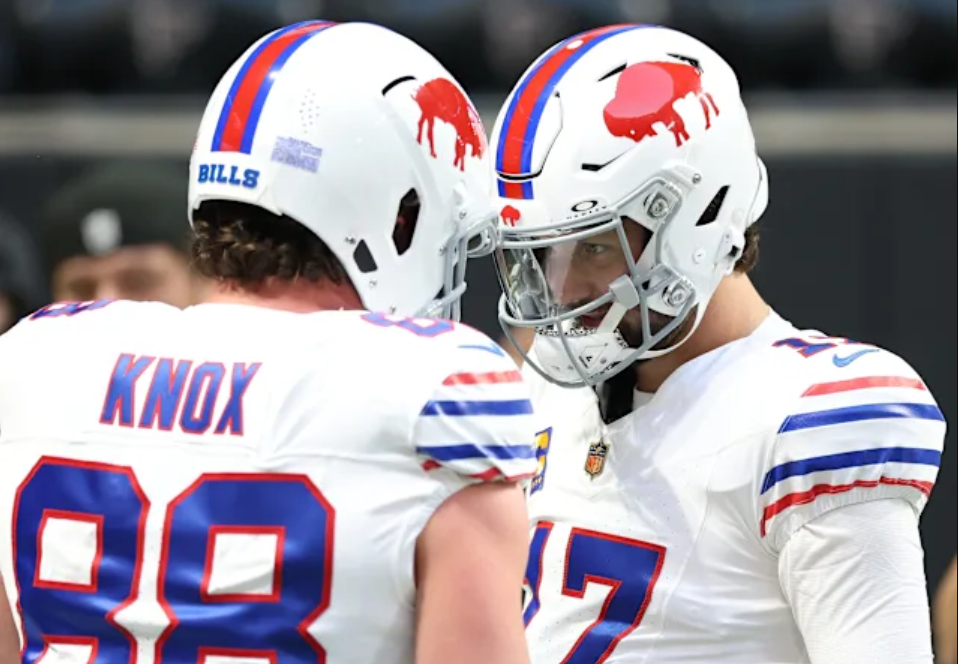
The Buffalo Bills have several important financial decisions to sort through as they navigate the offseason, and one of the most notable involves veteran tight end Dawson Knox. As things currently stand, Knox is scheduled to carry a hefty $17.8 million salary cap hit into the upcoming 2026 campaign. For a team already working through cap constraints, that figure is significant enough to demand careful evaluation.
While Knox has been a steady presence in Buffalo’s offense and locker room, his cap number looms large relative to his recent production and overall role. In today’s NFL, roster building often requires difficult choices, and even respected veterans can find themselves at the center of financial recalibration.
That appears to be the case here. The Bills are widely expected to approach Knox about restructuring his contract in an effort to reduce his cap hit and create some much-needed breathing room.
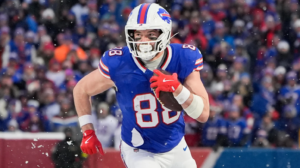
Still, there is no certainty that a revised agreement will ultimately come together. Negotiations in situations like this can be delicate. Players understandably want to protect their earning power and long term security, while teams must weigh sentiment against the cold arithmetic of the salary cap. That tension was acknowledged publicly by Buffalo’s top decision maker during a recent media session.
Speaking at the NFL Scouting Combine, general manager Brandon Beane addressed Knox’s contract status and offered insight into where things stand. Beane, who serves as both President of Football Operations and General Manager, indicated that the organization is fully aware of the financial challenge Knox’s deal presents.
“He has a tough [cap hit] as we go into the season, so we’ve gotta figure that out, as we do,” Beane explained, according to WGR 550’s Sal Capaccio. His comments underscored that the team recognizes the issue and intends to approach it proactively rather than letting it linger into training camp.
Beane also made it clear that discussions have already begun. “Dawson and I had dialogue,” he said, emphasizing that communication between the two sides is underway. Rather than framing the situation as adversarial or contentious, Beane characterized it as part of the normal business process that teams and veteran players often navigate together.
According to Beane, the foundation of these talks rests on mutual respect. “I think it just starts with trust, communication, and honest conversation,” he noted. Those words suggest that the Bills are attempting to handle the matter collaboratively, recognizing Knox’s leadership and tenure with the franchise while still acknowledging the financial realities at hand.

From Buffalo’s perspective, retaining Knox likely remains the preferred outcome provided the numbers can be adjusted to something more manageable. The 29 year old is coming off one of his stronger seasons in recent memory.
Though he may not be among the league’s elite tight ends statistically, he remains a reliable target in the passing game and a physical presence in both red zone situations and run blocking assignments.
Knox’s value extends beyond the stat sheet. He has been part of the team’s core during its recent playoff runs and is viewed as a respected voice in the locker room. That kind of institutional stability carries weight, particularly for a team that continues to pursue a championship window built around its established stars. Letting a player like Knox walk is not a decision the Bills would make lightly.
However, the financial math complicates matters. Buffalo entered the offseason roughly $10 million over the salary cap, which immediately put pressure on the front office to identify savings. In that context, Knox’s $17.8 million cap charge stands out as one of the more flexible levers the team could pull.
According to figures from Spotrac, releasing Knox before June 1 would free up approximately $10.4 million in cap space.
That potential savings is substantial for a team seeking to become compliant while also preserving the ability to make strategic additions. Of course, cutting Knox would also leave a void at tight end and potentially create dead money implications, but the cap relief would be immediate and meaningful.
The decision, then, becomes a balancing act. If Knox is willing to restructure perhaps by converting base salary into bonus money, extending the contract to spread out the cap hit, or accepting a pay reduction the Bills could maintain continuity while alleviating financial strain. If not, Buffalo may be forced to consider the more drastic option of parting ways.
Situations like this are emblematic of the broader roster management challenges NFL teams face each year. The salary cap, while designed to promote parity, often compels front offices to make difficult calls involving respected veterans. Even productive players can become cap casualties if their contracts no longer align with team priorities.
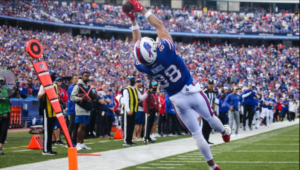
For Knox, the coming weeks will be pivotal. At 29, he remains in his prime years athletically, but this stage of a career can also be when teams begin reassessing long term value versus cost.
A willingness to collaborate on a revised deal could secure his place in Buffalo for years to come. On the other hand, holding firm on his current terms might test the organization’s appetite for absorbing such a significant cap burden.
For the Bills, the goal is straightforward; find a solution that strengthens the roster overall. That may mean preserving Knox at a lower number, or reallocating his cap space to address other needs across the depth chart. In either case, Beane’s comments suggest that transparency and mutual respect are guiding the process.
Ultimately, the outcome will hinge on whether both sides can align their expectations. Buffalo appears open to keeping one of its veteran leaders, but not at any cost. As negotiations continue, the organization must weigh loyalty and performance against fiscal responsibility.
In the modern NFL, those decisions are rarely simple. But as the 2026 season approaches, resolving Knox’s contract situation will be one of the key dominoes that shapes how the Bills construct their roster and how much flexibility they possess to pursue further upgrades.
A good year
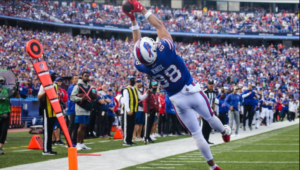
Dawson Knox turned in a productive and quietly impressive 2025 season, suiting up for all 17 regular season contests and finishing with 36 receptions, 417 receiving yards, and four touchdowns.
Each of those numbers represented an improvement over his totals from the previous year, signaling a resurgence in both opportunity and effectiveness within the offense. While his stat line may not have placed him among the league’s elite tight ends, it marked his strongest overall campaign since 2022, when he posted 48 catches for 517 yards and six scores in just 15 appearances.
That earlier season had been widely viewed as a benchmark for his impact in the passing game, and his 2025 output suggested he was once again trending in the right direction.
Throughout the 2025 campaign, Knox became an increasingly important component of the Buffalo Bills offensive attack. His role grew more substantial at various points during the year, particularly as the team navigated ongoing injury concerns surrounding fellow tight end Dalton Kincaid.
With Kincaid battling health issues that limited his availability and consistency, Knox was often called upon to shoulder additional responsibilities, both as a pass catcher and as a dependable in line presence. He responded by providing stability and reliability, giving the coaching staff confidence that the tight end position would not become a liability amid the uncertainty.
Knox’s value during that stretch extended beyond raw production. He demonstrated an understanding of situational football, frequently serving as a security blanket in key downs and red zone scenarios. His ability to find soft spots in coverage and maintain strong chemistry with the quarterback proved vital when the offense needed steady execution.

While he has long been recognized for his athleticism and physical tools, the 2025 season highlighted his maturity and adaptability. Rather than seeing his role diminish with the arrival of a younger, highly drafted tight end, Knox embraced the evolving dynamic and continued contributing in whatever capacity was required.
That adaptability has become one of Knox’s defining traits since entering the league. After being selected in the 2019 draft, he steadily developed into a core offensive piece. His progression culminated in the lucrative four year, $53.6 million contract extension he signed in 2022, a deal that underscored the organization’s belief in his long term importance. At the time, the extension signaled that he would remain a focal point of the tight end room for years to come.
However, roster building in the NFL rarely remains static. The drafting of Kincaid introduced a new layer of competition and long-term planning at the position. Many veterans might have bristled at the idea of a potential successor being brought in so soon after a sizable payday. Instead, Knox handled the transition professionally.
General manager Brandon Beane publicly praised him for maintaining a team first mindset, noting how Knox continued to do whatever was asked of him, even as the offensive hierarchy shifted.
Beane’s comments reflected the organization’s appreciation for Knox not only as a player but also as a leader. The veteran tight end has been part of the team’s offensive evolution, witnessing changes in personnel and scheme while remaining a steady presence in the locker room.
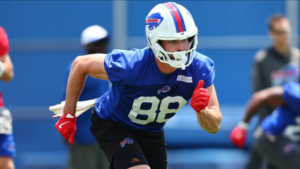
His willingness to adapt whether that meant taking on more blocking duties, accepting fewer targets in certain game plans, or stepping into a larger role when injuries struck has reinforced his standing within the franchise.
Financial considerations, though, complicate the picture moving forward. Despite Knox’s productive 2025 season and the respect he commands within the organization, the team cannot realistically retain him under the terms of his current contract structure.
The economics of the salary cap demand flexibility, particularly for teams with championship aspirations and several high priced stars already on the books. While Knox previously agreed to restructure his contract in March 2024 reducing his cap hit from $14.3 million to $7.7 million for that season such maneuvers typically provide only temporary relief rather than a permanent solution.
That earlier reworked deal demonstrated Knox’s willingness to collaborate with management in pursuit of roster stability. By lowering his cap number, he gave the front office breathing room to address other needs.
Still, as his contract progresses, the financial burden rises again, forcing the organization to confront difficult decisions about resource allocation. Paying top tier money to a tight end who may function as part of a rotational tandem rather than a clear cut No. 1 option presents a challenge in a league driven by cost efficiency.
At the same time, the Bills must carefully weigh the importance of depth at a physically demanding position. Tight ends endure significant wear and tear, and Kincaid’s recent injury history underscores the risk of relying too heavily on a single player. Knox has proven he can step in and produce when called upon, offering a form of insurance that few teams possess. Allowing him to depart without a viable contingency plan could leave the offense vulnerable if health issues resurface.
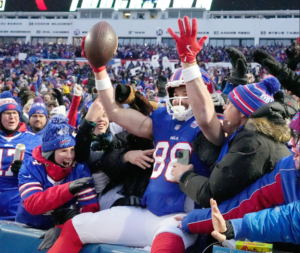
Ultimately, the situation reflects the delicate balance between loyalty, performance, and fiscal responsibility. Knox’s 2025 resurgence reaffirmed that he remains a capable and valuable contributor.
His improved numbers, durability across a full 17 games slate, and steady presence during Kincaid’s absences highlighted his continued relevance. Yet the realities of the salary cap may necessitate renegotiation, restructuring, or even a parting of ways if a mutually agreeable solution cannot be reached.
For now, Knox’s tenure with the Bills stands as a testament to steady growth and professionalism. From his early development after being drafted in 2019 to his peak statistical seasons and subsequent adaptation to a changing role, he has consistently demonstrated resilience and team first commitment.
Whether the next chapter involves a revised contract in Buffalo or a new opportunity elsewhere, his 2025 performance served as a reminder that he remains a productive tight end capable of contributing meaningfully when given the chance.