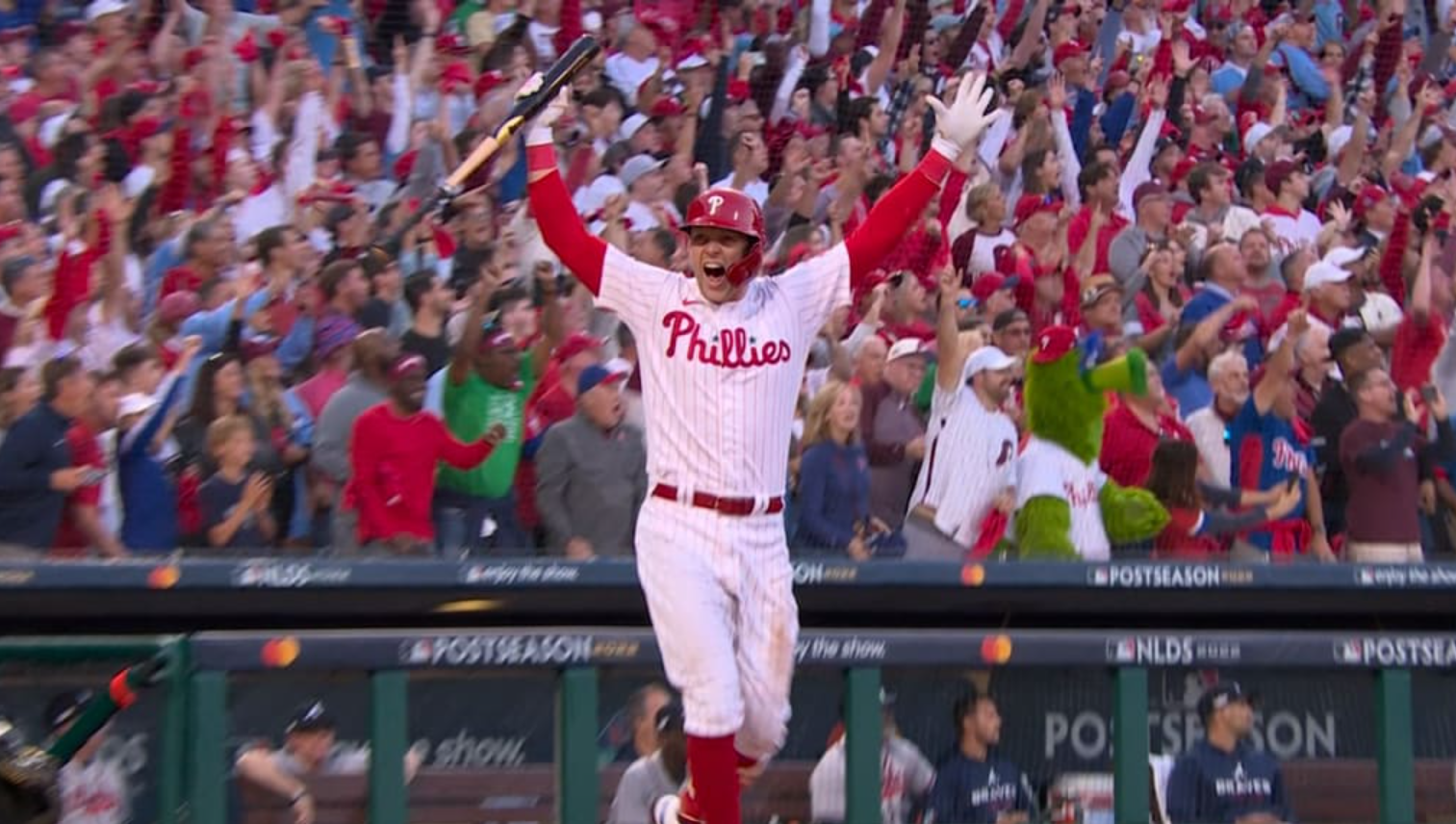
The Philadelphia Phillies have devoted much of their offseason energy to retaining two of their most important veteran leaders, Kyle Schwarber and J.T. Realmuto, ensuring that key pieces of their lineup and clubhouse presence remain intact.
Those efforts were viewed as significant priorities for the organization, as both players have been central to the club’s recent success. However, there may be another familiar name who could potentially find his way back to Philadelphia if Bryce Harper has his way.
According to Devan Kaney of SportsRadio 94WIP Philadelphia, Harper has expressed interest in seeing the Phillies pursue free agent first baseman Rhys Hoskins. Harper, now an All-Star at first base himself, reportedly has encouraged the front office to consider bringing Hoskins back into the fold.
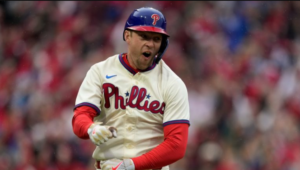
While Hoskins is said to be open to the idea of a reunion with his former team, the same level of enthusiasm may not be shared throughout the organization. Kaney reports that president of baseball operations Dave Dombrowski has not appeared particularly eager about making such a move.
Hoskins’ history with the Phillies runs deep. The organization selected him in the fifth round of the 2014 Major League Baseball Draft, and he steadily climbed through the minor league system before establishing himself as a key contributor at the big league level. He ultimately spent the first six seasons of his Major League career in Philadelphia, becoming one of the club’s most recognizable and productive power hitters during that stretch.
When Hoskins debuted in 2017, he made an immediate impact. His powerful bat and ability to reach base quickly caught the attention of fans and analysts alike. That season, he finished fourth in National League Rookie of the Year voting, signaling his arrival as one of the league’s promising young sluggers.
Over the next several years, he continued to supply consistent power to the Phillies’ lineup, recording multiple 30 home run campaigns and serving as a steady run producer in the middle of the order.
Beyond the numbers, Hoskins developed into a respected presence within the clubhouse. His familiarity with the organization, the city, and many of his former teammates adds an emotional layer to the possibility of a return.
For Harper, who has been a central figure in Philadelphia’s resurgence as a contender, the idea of reuniting with Hoskins likely carries both competitive and personal appeal. Harper’s advocacy suggests he believes Hoskins could still provide value, whether as a complementary bat or in a more flexible role depending on roster construction.
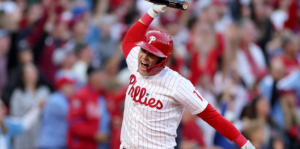
However, the situation is not without complications. A torn ACL suffered by Hoskins cost him the entire 2023 season and effectively marked the end of his first tenure with the Phillies. The injury not only sidelined him for a full year but also introduced uncertainty about how he might perform moving forward. Recovering from such a significant knee injury can be challenging, particularly for a player whose defensive responsibilities at first base require mobility and stability.
From the front office’s perspective, there are likely several factors to weigh. The Phillies have already committed significant financial resources this offseason, and roster balance remains a priority. With Harper entrenched at first base and other positions largely accounted for, the club would need to determine how Hoskins would fit into the current lineup. There may also be concerns about redundancy, defensive flexibility, and long-term planning.
Still, the possibility of a reunion has undeniable intrigue. Hoskins’ power potential and familiarity with Philadelphia’s market could make him an appealing depth addition if the financial terms align and the medical evaluations are favorable. For fans, the idea of welcoming back a former homegrown star who played a meaningful role in the team’s recent competitive window would likely generate excitement.
Ultimately, while Harper’s support for bringing Hoskins back has added fuel to speculation, the final decision rests with Dombrowski and the Phillies’ leadership group. The organization must balance sentiment with strategy, assessing whether a reunion would strengthen their pursuit of a championship. Whether or not Hoskins returns, his impact on the franchise during his initial six year run remains a significant chapter in Phillies history.
Bryce Harper Wanted the Philadelphia Phillies to Pursue Rhys Hoskins
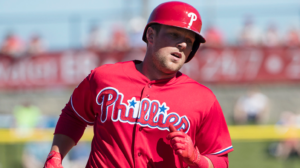
Throughout his tenure with the Philadelphia Phillies, Rhys Hoskins consistently performed as a hitter who produced well above league average. In fact, even what could be considered his least productive season in Philadelphia still reflected strong offensive value.
Back in 2019, his lowest weighted runs created plus (wRC+) with the club sat at 112 a figure that still placed him comfortably above the league norm. That year, despite some inconsistencies at the plate, he managed to launch 29 home runs, reinforcing his reputation as a dependable source of power in the middle of the lineup.
However, his time in Philadelphia ultimately took an unfortunate turn due to a significant knee injury. The ACL tear not only cut short his contributions but may have also altered the trajectory of his future with the organization. After he worked his way back to health, the Phillies opted not to pursue a reunion in free agency.
Instead of bringing back a player who had been a key offensive piece for several seasons, the front office chose to move in a different direction. That decision opened the door for Hoskins to continue his career elsewhere, and he eventually signed with the Milwaukee Brewers.
His first season back from the ACL injury proved to be challenging. In 2024 with Milwaukee, Hoskins posted a slash line of .214/.303/.419 across 131 games. While he still displayed his trademark power by hitting 26 home runs, the overall offensive production was uneven.
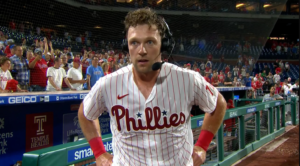
Perhaps most concerning was the spike in strikeouts. Hoskins struck out in 28.8% of his plate appearances, marking the highest strikeout rate of his career. The combination of diminished batting average and increased swing and miss tendencies suggested that he was still working to regain his rhythm following the lengthy rehab process.
Despite those struggles in 2024, there were encouraging signs that he was rediscovering his form the following season. Early in the year, Hoskins looked much more like the hitter Brewers fans had hoped they were getting. Through the end of May, he carried an impressive .849 OPS and served as a key driving force in Milwaukee’s offense.
Batting in a prominent role within the lineup, he helped generate run production and provided stability in the middle of the order. For a stretch, it appeared as though he had successfully put the worst of his post injury struggles behind him.
Momentum, however, can be fragile over the course of a long season. After a strong start, Hoskins endured a rough patch in June, as his production dipped and the consistency he had shown earlier began to waver.
Then, in early July, another setback struck. He suffered a thumb injury that forced him out of action and stalled what had been shaping up to be a bounce back campaign. The timing was particularly unfortunate, as he had only recently begun to reestablish himself as one of the team’s primary offensive contributors.
While Hoskins was sidelined, the Brewers’ front office acted aggressively to bolster the roster. Milwaukee swung a trade with the Chicago White Sox to acquire first baseman Andrew Vaughn, a former No. 3 overall draft pick who had shown flashes of potential but struggled to find consistency in Chicago.
The change of scenery appeared to unlock something in Vaughn. After joining Milwaukee, he thrived in his new environment and quickly became one of the club’s most productive hitters.
Vaughn’s surge created a complicated situation once Hoskins was ready to return from his thumb injury. With Vaughn entrenched at first base and delivering strong performances, there was no longer a clear everyday role available for Hoskins.
Rather than reclaiming his previous spot in the lineup, the veteran found himself relegated to a bench role. The shift represented a significant change for a player who had long been accustomed to regular at bats and middle of the order responsibilities.
The difficult turn of events culminated at season’s end. When Milwaukee finalized its postseason roster, Hoskins was notably absent from the list. Being left off the playoff squad underscored how dramatically his standing had shifted over the course of the year.
From early season catalyst to sidelined veteran fighting for opportunities, his role diminished in a matter of months. What once seemed like a promising rebound campaign ultimately became another chapter marked by injury, competition, and uncertainty about his long-term place with the organization.
Is There Room For Hoskins in Philadelphia?
Once the Phillies made the decision to bring Kyle Schwarber back into the fold, it initially appeared that there was no clear avenue to add another bat who primarily fits at first base or designated hitter.
On paper, the lineup seemed set, and there didn’t seem to be a natural opening for someone with that specific skill set. But the situation shifted when the organization opted to part ways with veteran outfielder Nick Castellanos, who had grown frustrated with his role.
Philadelphia ultimately decided to release him, even though that meant absorbing the remaining $20 million on his contract. The move underscored the club’s willingness to move on despite the financial hit. Castellanos has since landed with the San Diego Padres, bringing his tenure in Philadelphia to an end.
With Castellanos no longer in the picture, a subtle but intriguing opportunity has emerged for the Phillies to explore adding a right handed bat to bolster their bench. If president of baseball operations Dave Dombrowski were inclined to reconsider his previous stance on roster construction, there could now be room to bring in a player who thrives in specific matchups.
Rhys Hoskins, for example, would represent a logical candidate in that scenario. Throughout his career, Hoskins has consistently punished left handed pitching, compiling an impressive .882 OPS over 1,012 plate appearances against southpaws. That track record suggests he could provide real value in a platoon or matchup based role.
Realistically, Hoskins would not supplant Bryce Harper at first base or Schwarber at designated hitter in the everyday lineup. Both players are entrenched in key offensive roles and are central to the Phillies’ plans.
However, Hoskins’ ability to excel against left handed pitching could make him an asset in games where the Phillies face particularly challenging southpaw starters or relievers. In those situations, deploying him strategically could give the offense an added edge without disrupting the core lineup structure.
The fit becomes even more seamless if the Phillies are willing to utilize Schwarber in the outfield on occasion. While Schwarber has primarily served as a designated hitter, he does have experience in left field.
If the team were comfortable giving him time in the outfield especially in matchups that warrant a more offense oriented alignment Hoskins could slot in at DH. That alignment would allow the club to maximize platoon advantages while still keeping its most potent bats in the lineup.
Meanwhile, the projected outfield alignment also factors into the equation. Brandon Marsh appears to be trending toward serving as the primary left fielder when the Phillies face right handed pitching.
His skill set plays well in those matchups, and the organization seems prepared to give rookie Justin Crawford an opportunity to handle everyday duties in center field. Crawford’s emergence would inject youth and athleticism into the lineup, potentially solidifying a key defensive position for years to come.
However, Marsh’s career splits reveal a significant vulnerability against left handed pitching. He has managed just a .581 OPS against same handed pitchers, a stark contrast to his performance versus righties. Given those struggles, it stands to reason that Marsh would sit against most left handed starters.
That’s where someone like Hoskins could become particularly valuable. In games started by lefties, the Phillies could rearrange their alignment moving Schwarber into the outfield, using Hoskins at DH, and optimizing the lineup to attack favorable matchups.
Such flexibility would give manager Rob Thomson more options and allow the team to tailor its offensive approach based on the opposing pitcher. While Hoskins wouldn’t be counted on as an everyday fixture, his presence could strengthen the bench and provide a dependable weapon in specific situations.
Castellanos’ exit may have initially seemed like a simple subtraction, but it has quietly opened the door for creative roster maneuvering and the possibility of enhancing the Phillies’ offense in a targeted, strategic way.