The New York Rangers suffered a notable blow to their physical presence and edge on Friday, as several beat reporters confirmed that forward Matt Rempe will be placed on injured reserve and is set to undergo thumb surgery.
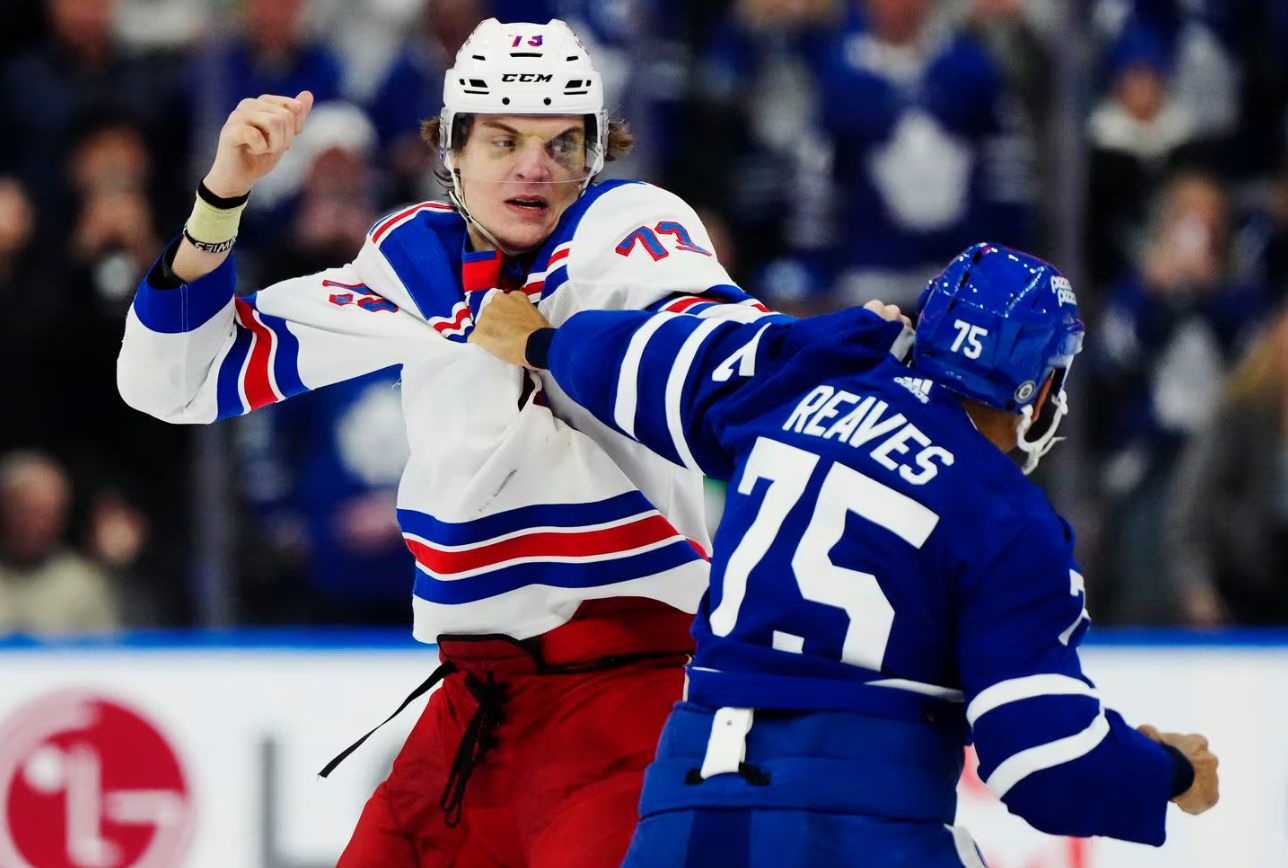
Rempe, who has quickly developed a reputation as a fan favorite thanks to his imposing style and willingness to drop the gloves, had been dealing with a fractured thumb for months. The injury lingered longer than initially expected, and despite efforts to manage it conservatively, it never fully healed. Ultimately, the organization and medical staff determined that surgery was the best course of action to address the issue once and for all.
The timing is particularly unfortunate for the Rangers. With the Olympic break wrapping up, teams across the league are preparing to resume play and gear up for the stretch run.
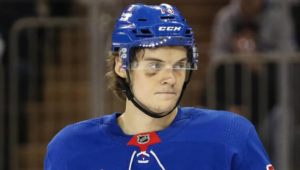
Instead of welcoming back a fully healthy lineup, New York will now have to move forward without one of its most physically imposing forwards for the foreseeable future. While Rempe’s offensive production may not headline box scores, his physicality, energy, and ability to shift momentum with a big hit or spirited fight have made him a valuable presence in the lineup.
Reports indicate that the thumb injury had been bothering Rempe for quite some time. Broken thumbs can be especially troublesome for hockey players, as grip strength is crucial for stickhandling, shooting, and battling along the boards.
Even routine plays can become painful or compromised when such an injury lingers. Though Rempe attempted to play through the discomfort, the lack of proper healing eventually left the team with little choice but to pursue a surgical fix.
By opting for surgery now, the Rangers are hoping to provide a long term solution rather than risk further complications. A procedure should allow the thumb to heal correctly and restore full function, even if it means losing Rempe for a stretch during a critical portion of the schedule. Placing him on injured reserve opens up a roster spot, giving the team some flexibility to call up a replacement or adjust its forward lines accordingly.
For a player whose identity is so closely tied to toughness and physical engagement, a thumb injury can be particularly limiting. Every fight, every board battle, and every net front scrum requires firm hand strength and stability. Without it, Rempe would not be able to perform at the level that has endeared him to the Madison Square Garden crowd.
While there is no definitive timeline yet for his return, the expectation is that surgery will give him the best chance to come back at full strength. In the meantime, the Rangers will have to compensate for the loss of one of their most rugged contributors as they transition out of the Olympic pause and back into the grind of the NHL season.
Rempe’s had a tough season
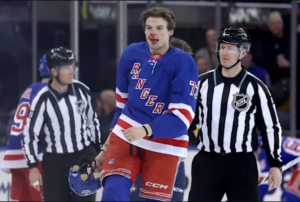
The 2025/26 campaign has unfolded as a deeply frustrating chapter in the young career of Matt Rempe. What once looked like a season that could help him build on flashes of promise has instead become a cautionary tale about injuries, development, and questionable decision making.
Rather than allowing him the time and space to properly recover and reset, the organization chose to accelerate his return. That choice has lingered over everything that has followed.
From the outset, Rempe has been dealing with a nagging injury that clearly limited his effectiveness. Instead of shutting him down until he was fully healthy particularly in a year that has slipped away in the standings the team opted to reintegrate him into the lineup before he was truly ready. The result has been a player trying to rediscover his game while physically compromised, a scenario that benefits neither the athlete nor the franchise.
To compound matters, the Rangers have not definitively closed the door on another return for Rempe, even with just 25 games remaining in what has effectively become a lost season.
The team is far removed from meaningful playoff contention, and yet there appears to be a lingering temptation to push him back into action. In a year where long term priorities should outweigh short term optics, that approach raises legitimate concerns.
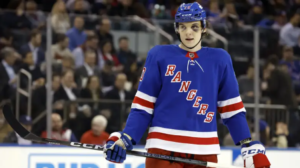
Reports earlier in the month painted a troubling picture. Rempe was still struggling with something as fundamental as gripping his stick as recently as January. This revelation came after he had already been back in the lineup for 12 games following a two month absence.
For a hockey player, stick control is not a minor detail it is central to shooting, passing, puck battles, and defensive positioning. The idea that he was attempting to compete at the NHL level while still battling such a basic functional limitation underscores just how premature his return may have been.
The situation became even more precarious during a lopsided loss to the Boston Bruins. With the Rangers being thoroughly outplayed, Rempe reportedly contemplated dropping the gloves. Under normal circumstances, fighting is part of his established identity.
However, engaging in a fight while dealing with compromised grip strength and lingering injury concerns would have bordered on reckless. In that moment, what could have been framed as a show of toughness might just as easily have turned into a catastrophic setback.
Around that same period, head coach Mike Sullivan acknowledged that Rempe was “in a tough spot because he’s trying to get better on the fly.” That comment, though perhaps intended to show empathy, inadvertently highlights the core issue.
Development in the NHL is difficult enough under optimal circumstances. Attempting to refine one’s game while battling injury and adapting in real time to the speed of the league creates a nearly impossible environment for meaningful progress.
The decision to bring him back under those conditions appears misguided. Even at full health, Rempe projects as a fringe NHL contributor a player who must maximize specific strengths to justify a regular roster spot.
His value lies largely in his imposing size, willingness to play physically, and capacity to shift momentum with energy or intimidation. While he has expressed a desire to evolve into a more well rounded hockey player rather than being labeled strictly as an enforcer, his physical edge remains central to his effectiveness.
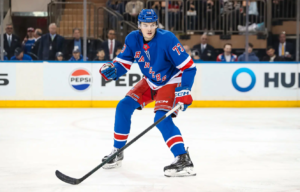
When that physical edge is blunted either because he cannot fully grip his stick, cannot safely engage in fights, or must shy away from heavy contact his overall impact diminishes significantly. Opposing teams quickly adjust. If they sense that he is unable or unwilling to play with his usual force, they no longer have to account for that disruptive element. What might otherwise be a net positive presence becomes far more neutral, or even detrimental.
This is especially problematic given his role. Rempe typically skates on the fourth line, where ice time is limited and responsibilities are defined. In that context, marginal advantages matter. A fourth line winger who cannot forecheck aggressively, battle along the boards with full strength, or protect teammates in scrums loses much of what differentiates him from replacement level options.
Moreover, the broader context makes the situation even more puzzling. The Rangers are not clinging to a playoff spot or fighting for home ice advantage. They are staring at the possibility of a draft lottery selection.
In such circumstances, protecting a young player’s long term health should take precedence over squeezing out incremental contributions in March and April. There is little to gain from risking further aggravation of an injury in games that carry minimal competitive stakes.
Even if Rempe reports feeling improved, that does not necessarily justify another return this season. Recovery is not always linear. Lingering issues can resurface under the physical demands of game action. The smarter approach would be to shut him down definitively, allow for full rehabilitation, and ensure that he enters the following season without residual limitations.
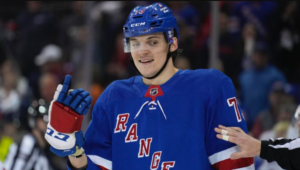
Statistically, his 2025/26 numbers reflect a player who has struggled to move the needle. In 26 games, Rempe has logged approximately 214 minutes at five on five, primarily in a fourth line capacity. During that span, the Rangers have posted a 38.19 percent goals for percentage with him on the ice, meaning they have been outscored significantly in his minutes.
His 49.58 percent Corsi for percentage suggests that the team has controlled slightly less than half of shot attempts when he plays, while his 51.41 percent expected goals for percentage indicates somewhat more favorable underlying chance quality.
On paper, those possession and expected goals metrics might hint at a player whose contributions are not entirely negative. However, context matters. The sample size is modest, and his limited usage averaging just 8:30 of ice time per game constrains his ability to tilt results. He has registered a single goal all season and carries a minus four rating. For a depth forward seeking to solidify his place, those outputs fall short of compelling.
It is also important to consider the psychological dimension. A young player fighting for his NHL future is likely to push himself beyond advisable limits. The drive to prove worth can override caution, especially in a league where opportunities are fleeting.
That dynamic makes it incumbent upon management and coaching staff to serve as safeguards. Protecting a player from himself is sometimes necessary, particularly when the long-term investment outweighs short term returns.
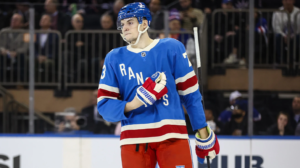
The Rangers’ handling of this situation risks sending a mixed message. On one hand, the organization wants Rempe to broaden his skill set and become more than a novelty act defined by size and fighting. On the other, they appear willing to deploy him in circumstances where he cannot fully utilize even his existing strengths. That contradiction hampers development and muddies evaluation.
In the grand scheme, the 2025/26 season should have been about incremental growth refining puck skills, improving positioning, learning the nuances of NHL pace. Instead, it has become a cycle of injury management, tentative returns, and diminished impact. For a player already described as borderline NHL caliber, lost developmental time carries real consequences.
There remains a path forward. By prioritizing complete recovery and crafting a structured offseason plan, the Rangers can still position Rempe for a more stable 2026/27 campaign. That would involve honest assessment, transparent communication, and a willingness to accept that shutting him down now may be the most responsible course of action.
Ultimately, the lesson from this disappointing season is clear: development cannot be rushed, and health cannot be compromised without cost. For Rempe and the Rangers alike, the focus should shift away from salvaging a few late season appearances and toward ensuring that when he next steps onto NHL ice, he does so at full strength and with a genuine opportunity to succeed.