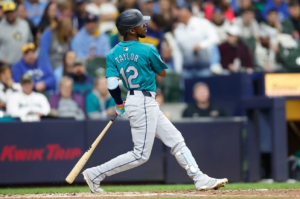
The Seattle Mariners’ decision to acquire right handed pitcher Yosver Zulueta from the Cincinnati Reds set off a domino effect that ultimately brought Samad Taylor’s time with the organization to a close.
While the move itself was largely about bolstering pitching depth, the roster mechanics that followed left Taylor without a spot. Fortunately for him, the separation from Seattle was brief, as he quickly found a new opportunity with the San Diego Padres.
To clear room for Zulueta on the 40 man roster, the Mariners designated Taylor for assignment on January 15. It was a procedural move rather than a shocking one, reflecting how tight roster decisions can become during the offseason.
After being placed on waivers, Taylor officially cleared on January 23, meaning no other club claimed him. With that hurdle passed, he exercised his right to elect free agency, opening the door to explore new possibilities elsewhere.
That next chapter came swiftly. According to Chris Cotillo of MassLive.com, Taylor agreed to a minor league contract with the Padres.
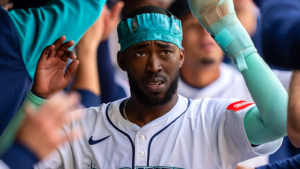
The deal also includes an invitation to major league spring training, giving him a chance to compete for a roster spot and put himself back on the radar ahead of the 2026 season. For a player seeking stability and a fresh start, it represents a timely opportunity with an organization known for creative roster usage and depth development.
There is also an ironic twist to the situation. Both the Mariners and Padres share the Peoria Sports Complex as their spring training home, which means Taylor will likely cross paths with members of the Seattle front office and coaching staff during camp.
Those encounters could be mildly awkward, serving as a reminder of how quickly circumstances can change in professional baseball. Still, such moments are part of the business, and players are well aware that roster decisions are rarely personal.
From Seattle’s perspective, Taylor’s departure is unlikely to have a significant impact moving forward. While he provided versatility and depth during his time in the organization, the Mariners appear comfortable with their current roster construction and depth options heading into 2026. The acquisition of Zulueta was viewed as a worthwhile investment, and the front office clearly felt that Taylor was expendable in order to make the numbers work.
For Taylor, however, the situation looks far more optimistic. The Padres have shown a willingness to give fringe major leaguers meaningful chances, especially those who can play multiple positions and contribute in different ways.
The big league spring training invite is particularly important, as it ensures Taylor will get exposure against top level competition rather than being buried in minor league camp from day one. Strong performance in Peoria could earn him a role as a bench piece, depth option, or at the very least, position him well for a midseason call up.
The move also highlights how fragile a player’s standing can be on a 40 man roster. One transaction especially one involving pitching, where depth is always in demand can force difficult decisions elsewhere. In Taylor’s case, it wasn’t a reflection of poor performance so much as a numbers game that favored organizational priorities.
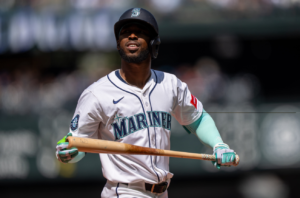
Ultimately, this transition may benefit both sides. The Mariners gain pitching depth and maintain roster flexibility, while Taylor gets a clean slate with a new organization and a clearer path to opportunity. If he can take advantage of his chance in San Diego, the brief and unceremonious end to his Seattle tenure could end up being a turning point rather than a setback.
As spring training unfolds in Peoria, Taylor will be focused less on any lingering awkwardness and more on proving he belongs at the highest level. Baseball has a way of recycling opportunities, and for players like him, persistence and adaptability often matter just as much as raw talent. In that sense, his story with the Padres is only just beginning.
Samad Taylor still looking for a long-term home
The truth of the matter is that Taylor’s professional journey has been anything but stable since the day his baseball career officially began. Drafted by the then Cleveland Indians in the 10th round of the 2016 MLB Draft, he entered pro ball with the hope of climbing steadily through one organization and eventually carving out a long term role at the highest level.
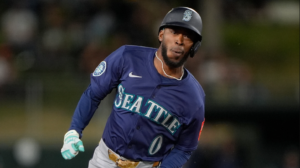
Instead, nearly a decade later, Taylor now finds himself on his fifth different team, a reality that underscores both the volatility of professional baseball and the challenges he has faced in establishing himself as a consistent major leaguer.
After beginning his career in Cleveland’s system, Taylor’s path soon took him elsewhere. He spent time with the Toronto Blue Jays organization before later joining the Kansas City Royals, each move representing another reset in his quest to prove he belonged.
His most recent transition before this latest chapter came at the start of the 2024 season, when he was traded to the Seattle Mariners. While the change offered renewed opportunity, it also added to a growing list of relocations that point to an ongoing search for the right fit.
This frequent movement between organizations reflects a broader reality: at 27 years old, Taylor is still trying to establish a permanent foothold in the big leagues. Despite years of development and flashes of promise, his exposure at the Major League level has been limited.
Across stints with both the Royals and the Mariners, he has appeared in just 38 MLB games total. That modest number speaks volumes about how difficult it has been for him to earn sustained playing time, even as teams continue to be intrigued by his athletic tools.
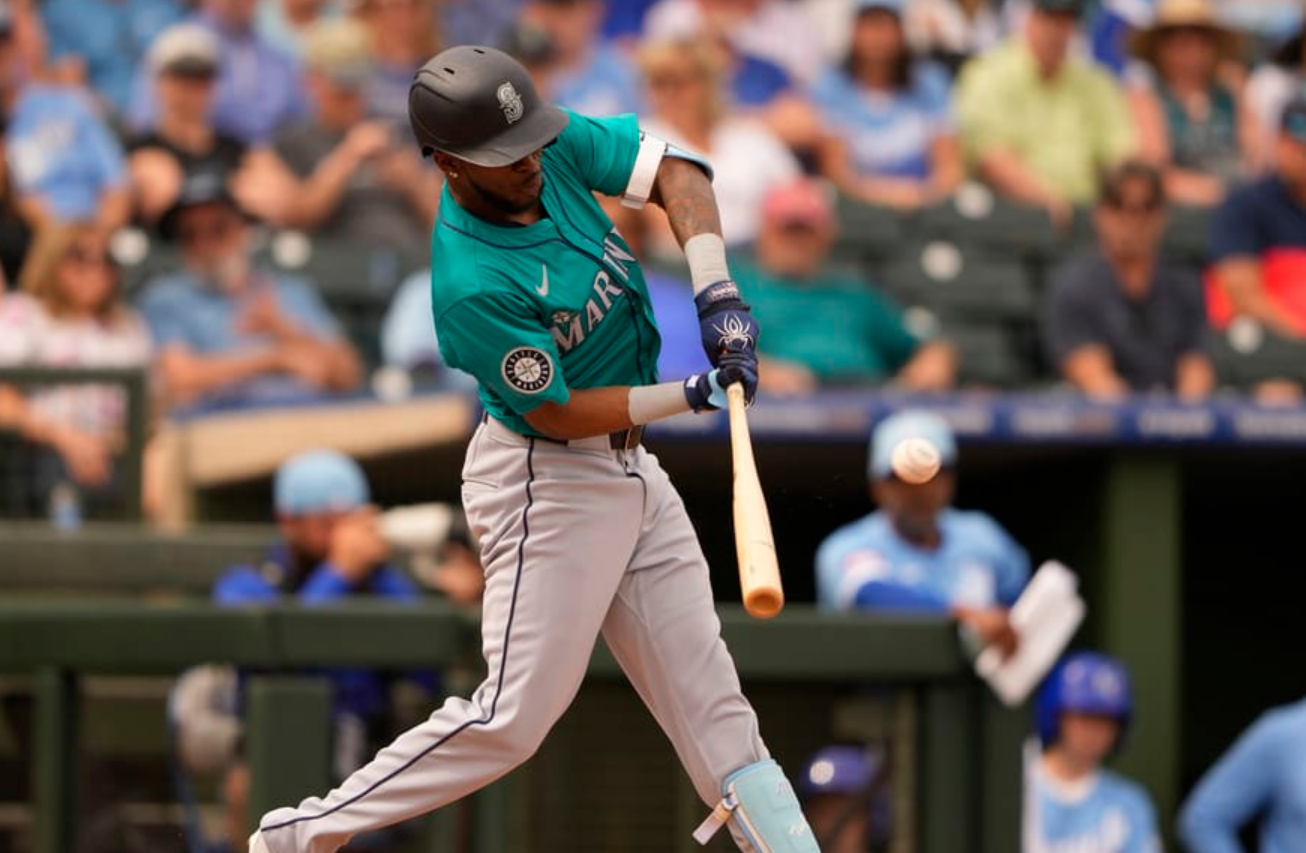
His time in Seattle, in particular, was brief and sporadic. Over the 2024 and 2025 seasons combined, Taylor suited up in only seven games for the Mariners. In those appearances, his offensive production was modest, as he posted a .231 batting average and a .462 on base plus slugging percentage.
While those numbers came from a small sample size, they did little to strengthen his case for a larger role, especially on a roster aiming to contend and relying on consistent production from its depth players.
That said, it would be unfair to frame Taylor’s career solely through the lens of limited Major League success. Beneath the surface, there are traits that continue to make him an intriguing option for teams willing to invest time and patience. Chief among those attributes is his elite speed. Few players in the minor leagues can match his quickness, a skill that has consistently stood out regardless of where he has played.
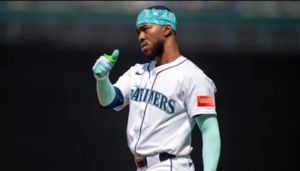
That speed was on full display during his time with Triple A Tacoma, where he stole an eye opening 94 bases over the course of two seasons. Those numbers don’t just highlight raw foot speed; they reflect strong instincts, aggressive baserunning, and a willingness to pressure opposing defenses. In an era where speed and versatility are increasingly valued, this aspect of Taylor’s game remains a significant asset.
Defensively, his athleticism translates just as effectively. Taylor has shown the ability to handle multiple positions across the diamond, a trait that adds to his appeal as a potential utility player. Over the years, he has logged time at shortstop, second base, and third base, while also seeing action in both left and right field. That level of defensive flexibility allows a team to deploy him in a variety of situations, whether as late game insurance, injury coverage, or matchup based depth.
Still, despite all these positive qualities, questions remain particularly when it comes to his bat. Perhaps the biggest uncertainty surrounding Taylor’s future centers on whether he can consistently harness his bat speed and raw power against Major League pitching. Scouts and coaches have long noted that the tools are there, but translating those tools into reliable production at the highest level has proven difficult.
There were encouraging signs in 2025, however. Playing a full season with the Tacoma Rainiers, Taylor appeared in 137 games and turned in the most productive offensive campaign of his professional career. He finished the year with a .296 batting average and an .839 OPS, numbers that suggested meaningful growth and improved approach at the plate. Those improvements raised optimism that he might finally be turning a corner offensively.
Even so, lingering concerns remain. Consistency has been an issue throughout his career, and success at the Triple A level does not always carry over to the majors. The gap between minor league pitching and Major League arms is significant, and Taylor still needs to demonstrate that he can make the necessary adjustments against elite velocity, sharper breaking pitches, and more advanced scouting reports.
From Seattle’s perspective, the timing simply worked against him. Entering the most recent offseason, Taylor was out of minor league options, meaning the Mariners could no longer shuttle him between the majors and Triple A without exposing him to waivers. At the same time, the organization had taken steps to reinforce its depth, bringing in additional players who better fit their immediate needs.
Complicating matters further was the influx of highly regarded prospects within the Mariners’ system. Compared to the previous year, Taylor would have faced even stiffer competition for Major League at bats in 2026, with younger players viewed as key pieces of the franchise’s future pushing for opportunities. In that context, it became increasingly clear that Taylor was no longer central to Seattle’s long-term plans.
Whether fair or not, the writing appeared to be on the wall. The Mariners, focused on maximizing roster efficiency and player development, opted to move on. For Taylor, that decision marked yet another turning point, but also another chance to reset and reestablish himself elsewhere.
Now, as he begins the next phase of his career with San Diego, there is a sense of cautious optimism. While his path has been winding, it is far from over. New surroundings often bring renewed motivation, and Taylor will have the opportunity to compete for a role in an organization that values speed, athleticism, and defensive versatility.
Spring training could prove especially meaningful. The familiar environment of the Peoria Sports Complex, where multiple teams share facilities, may offer a unique source of motivation. Regularly crossing paths with former teammates could serve as a reminder of how close he is and how much remains within reach if everything clicks.
Ultimately, most Mariners fans are likely to part with Taylor on good terms. While his time in Seattle was brief and his impact limited, there is a general understanding that effort and potential were never lacking. As he looks to finally settle in with a new organization and make San Diego home for the foreseeable future, there is hope that he can still fulfill the promise that once made him an intriguing draft pick nearly a decade ago.
Baseball careers are rarely linear, and Taylor’s story is a testament to perseverance in the face of constant change. Whether this next chapter becomes a breakthrough or simply another stop along the way, he carries with him the experience, resilience, and tools to keep chasing his Major League dream.